Research-Informed + Studio Exploration
Modes Are Behavior Laws
Why different AI-assisted creative work needs different behavioral modes.
As AI systems become more capable, creative work is changing rapidly.
Writers, artists, filmmakers, designers, and developers can now move from idea to prototype faster than ever before. But during the development of Blue Banana Media Studio, we repeatedly encountered a surprisingly simple problem: the assistant behaved the same way no matter what kind of work we were doing.
Whether brainstorming story ideas, reviewing sensitive material, coordinating production tasks, or exploring visual concepts, the system responded with roughly the same level of initiative, structure, and decisiveness.
That created friction.
Creative exploration became over-structured. Execution became overly conversational. Reviews drifted into rewriting. Authority became unclear.
The issue was not intelligence. The issue was behavior.
Different work needs different behavior.
Creative exploration, production execution, review, and audit work each require different expectations.
One Assistant, Many Gears
Human creative teams naturally shift behavior depending on context.
A brainstorming session behaves differently from a production sprint, a review meeting, a publishing checkpoint, or a safety audit.
But most AI systems still operate as though every interaction requires the same behavior model.
Blue Banana Media Studio began exploring a different idea: what if creative AI systems needed different behavioral “gears” depending on the kind of work being done?
This became one of the studio's foundational concepts: Modes are behavior laws.
Modes as Behavior Laws
At Blue Banana Media Studio, Modes are not personalities, prompt presets, or temporary moods.
Modes define initiative, structure, collaboration style, execution expectations, and behavioral boundaries.
Different kinds of creative work require different operational behavior.
Exploration requires flexibility. Production requires structure. Reviews require distance and clarity. Audits require boundaries.
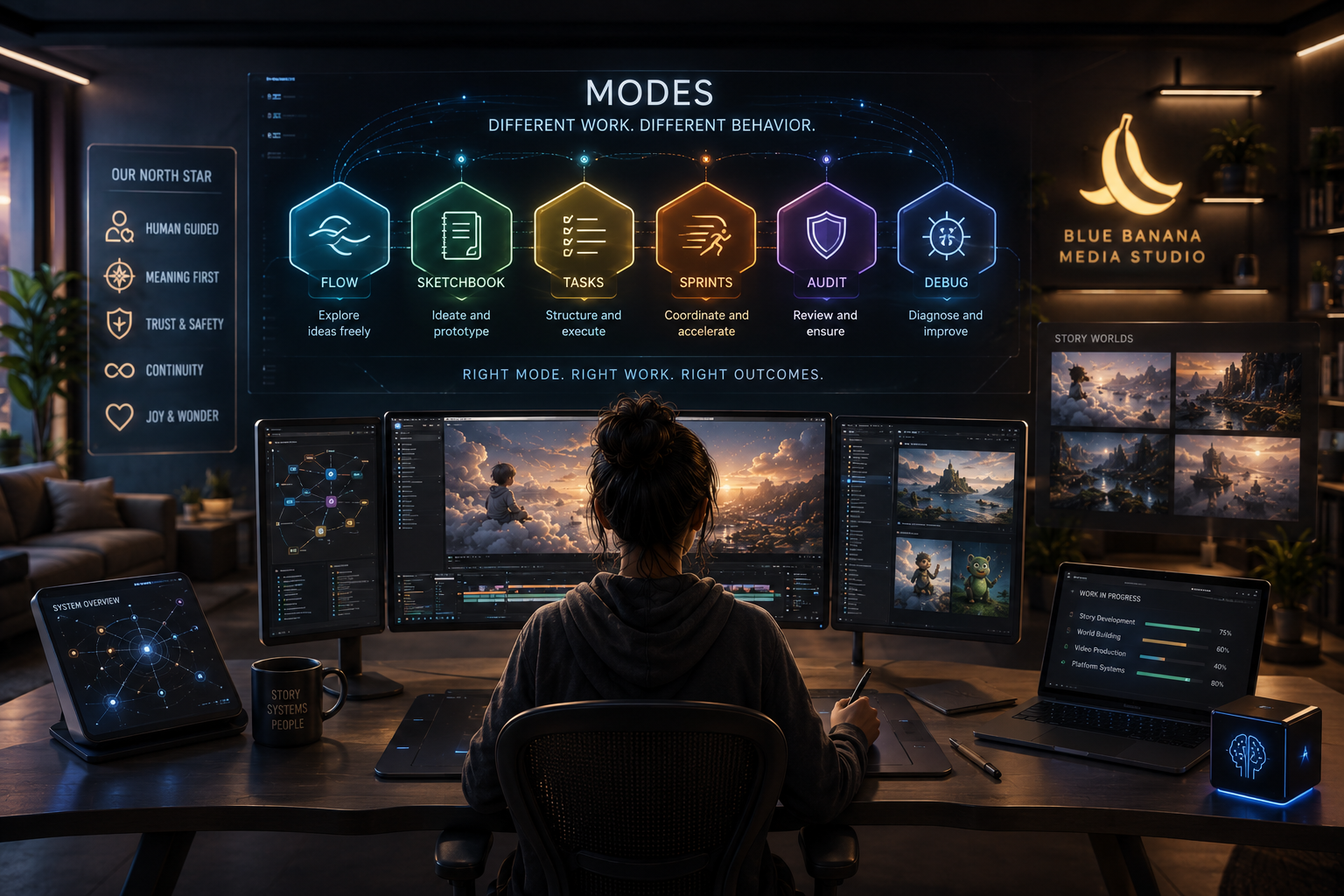
The studio currently uses different Modes depending on context, including FLOW, SKETCHBOOK, TASKS, SPRINTS, AUDIT, and DEBUG. Each one changes how the system behaves.
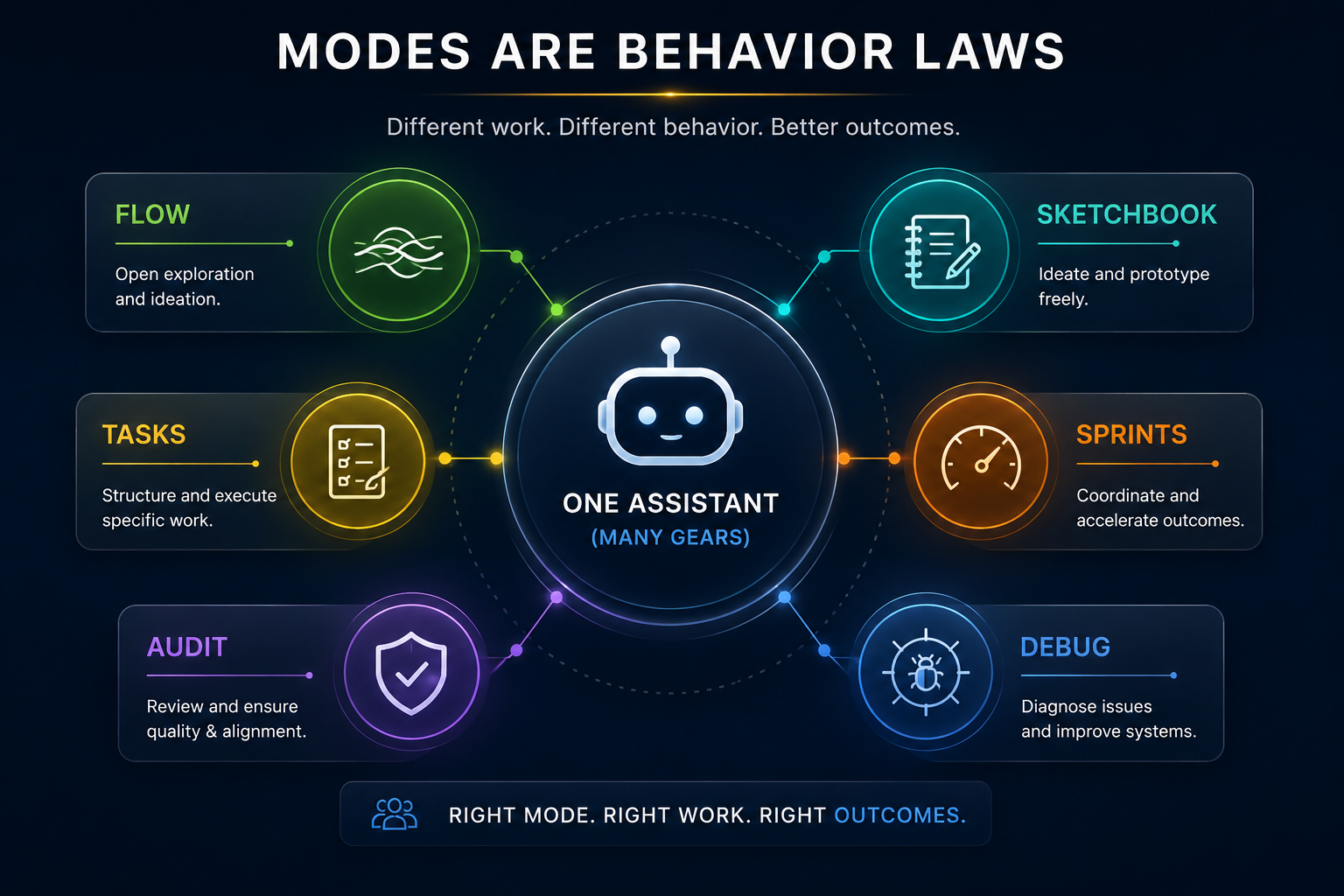
One assistant can support many kinds of work, but each kind of work needs a different behavioral mode.
Creativity and Execution Are Different
One of the studio's most important discoveries was that creative exploration and structured execution require very different interaction patterns.
During early ideation, too much structure can interrupt creative momentum.
But during production, too little structure can create drift, inconsistency, and confusion.
This led Blue Banana Media Studio to begin separating exploration behavior from execution behavior.
The goal is not rigid control. The goal is intentional behavior.
The goal is not rigid control. The goal is intentional behavior.
Why This Matters for AI Storytelling
As AI-native storytelling systems become more capable, governance becomes increasingly important.
This is especially true for children's media, emotionally meaningful storytelling, continuity-aware worlds, educational experiences, and long-lived creative systems.
The challenge is no longer simply generating content.
The challenge becomes preserving meaning, preserving trust, coordinating creativity responsibly, and scaling without losing coherence.
Blue Banana Media Studio is exploring whether adaptive behavioral systems can help support healthier human-AI collaboration, clearer authority boundaries, more trustworthy workflows, and emotionally grounded storytelling systems.
The goal is not removing humans from creativity. The goal is helping humans guide increasingly capable creative systems more intentionally.
Future Exploration
Blue Banana Media Studio is continuing to explore governance-aware creative systems, adaptive orchestration, continuity-aware storytelling, and emotionally grounded AI-native media systems.
Many of these ideas remain exploratory, evolving, research-informed, and actively tested in practice.
The studio does not view these systems as solved problems.
Instead, BBMS treats them as ongoing explorations into how meaningful storytelling may evolve in the AI era.