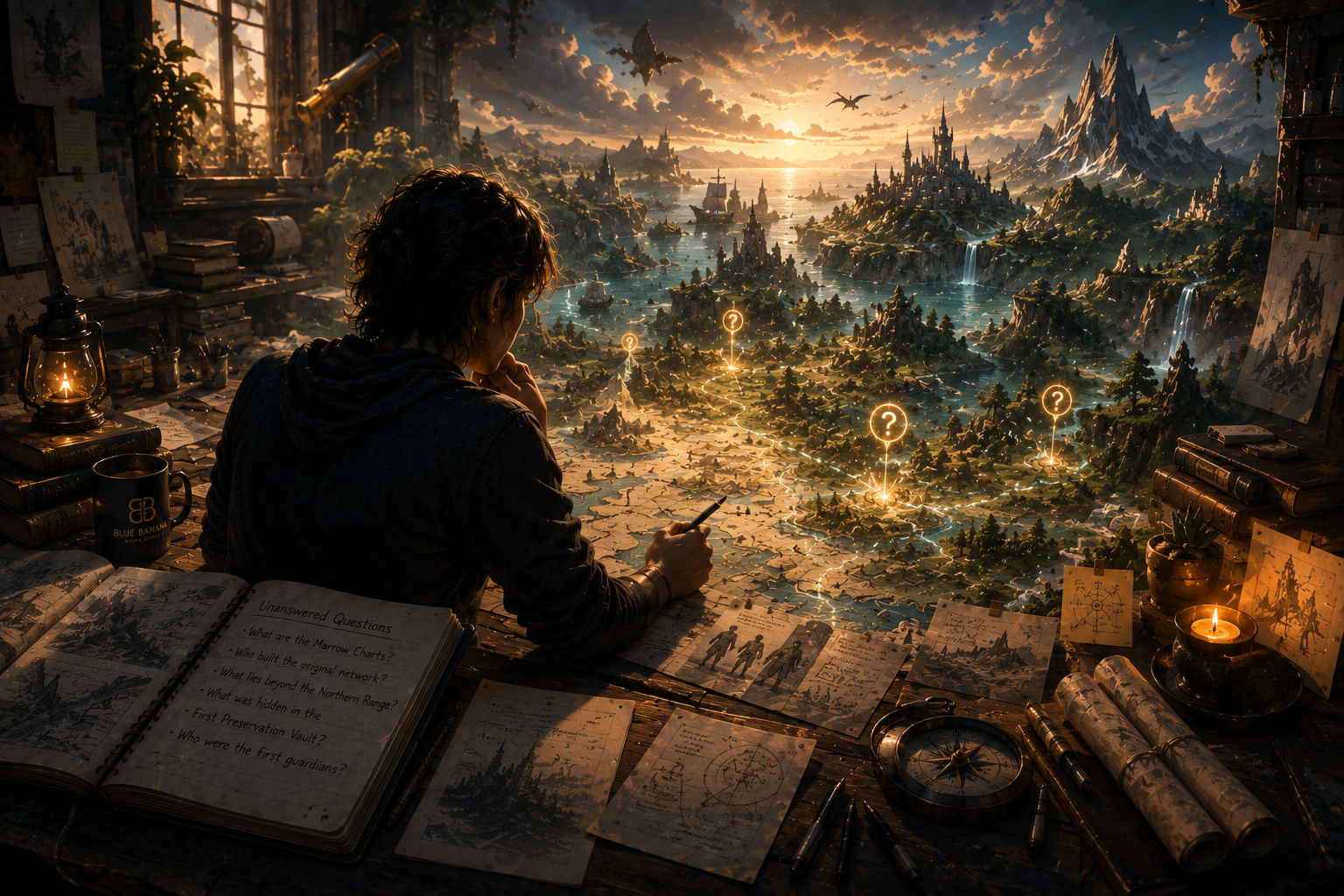
Research-Informed + Studio Exploration
Human-Guided AI World Development
How AI-assisted discovery, human approval, and repository-backed memory help creators build richer worlds without losing continuity.
While developing The Marrow Charts, an unexpected discovery emerged. The project was not only producing a fictional world. It was also producing a repeatable process for building complex worlds with AI while maintaining human control, continuity, and long-term consistency.
At first, the process looked familiar. There were conversations. Ideas. Characters. Locations. Questions. Possible stories.
But over time a more important realization appeared: World development is not simply about generating ideas. It is about preserving the right ideas while allowing discovery to continue.
This became one of the foundational ideas behind Blue Banana Media Studio's approach to world development.
The Challenge
AI conversations are remarkably effective at exploration. They can generate possibilities, discover patterns, connect ideas, and rapidly expand a creative space.
However, they also create a challenge. Important discoveries can become buried inside conversation history. Decisions can drift. Contradictions can emerge. Context becomes increasingly difficult to manage as projects grow.
For small creative teams, this problem becomes significant. Worlds often evolve over months or years. The larger the world becomes, the more difficult it becomes to remember why certain decisions were made.
The challenge is not discovery. The challenge is continuity.
Discovery vs Memory
One of the most important ideas to emerge from development was the distinction between Discovery and Memory.
Discovery is exploration. Memory is preserved knowledge. Discovery generates possibilities. Memory preserves decisions.
Not every discovery should become part of a world. Many discoveries are useful because they help reveal better questions, better directions, or better possibilities. Only reviewed and approved discoveries become part of the world record.
This distinction dramatically reduced continuity drift. Instead of treating conversations as memory, conversations became a discovery space. Memory became something separate. Something intentionally preserved.
Discovery is exploration. Memory is preservation.
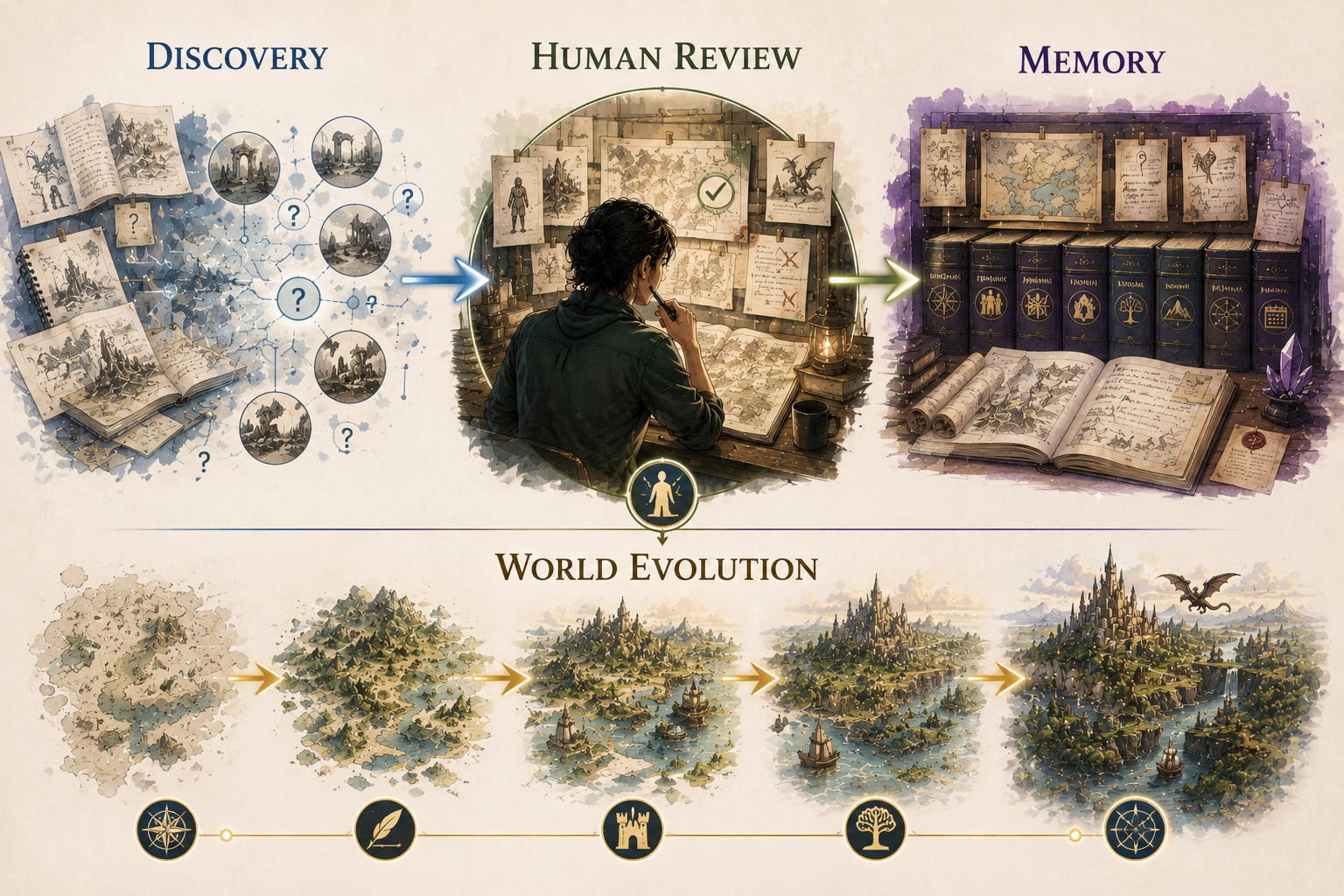
World development becomes more stable when discovery and memory are treated as separate systems.
Human-Guided World Development
The process intentionally avoids autonomous world creation.
AI assists with:
- Brainstorming
- Exploration
- Relationship discovery
- Pattern recognition
- Continuity analysis
- Scenario generation
Humans remain responsible for:
- Direction
- Approval
- Governance
- Canon formation
- Publication
The goal is not automated storytelling. The goal is augmented storytelling.
Over time a simple pattern emerged: Discovery → Human Review → Memory → World Evolution. AI helps discover possibilities. Humans determine which discoveries matter.
Repository-Backed Memory
As development continued, another realization emerged. Conversations were effective for exploration. They were not effective as long-term memory.
The solution was not more conversation. The solution was preservation.
Approved discoveries began moving into a repository-backed memory system. The repository became:
- Memory
- Archive
- Continuity reference
- Decision history
Conversation became discovery. The repository became memory. This allowed the world to continue evolving without losing important decisions.
Questions As Assets
Another unexpected discovery emerged. Questions are assets.
Many creative processes focus heavily on answers. World development often depends on preserving questions.
Examples from The Marrow Charts included:
- What are the Marrow Charts?
- Who built the original network?
- What was hidden in the First Preservation Vault?
These questions created future stories. Not every question needed an immediate answer. Some questions became long-term narrative engines.
The world grew stronger because certain mysteries remained alive.
Questions often create more stories than answers.
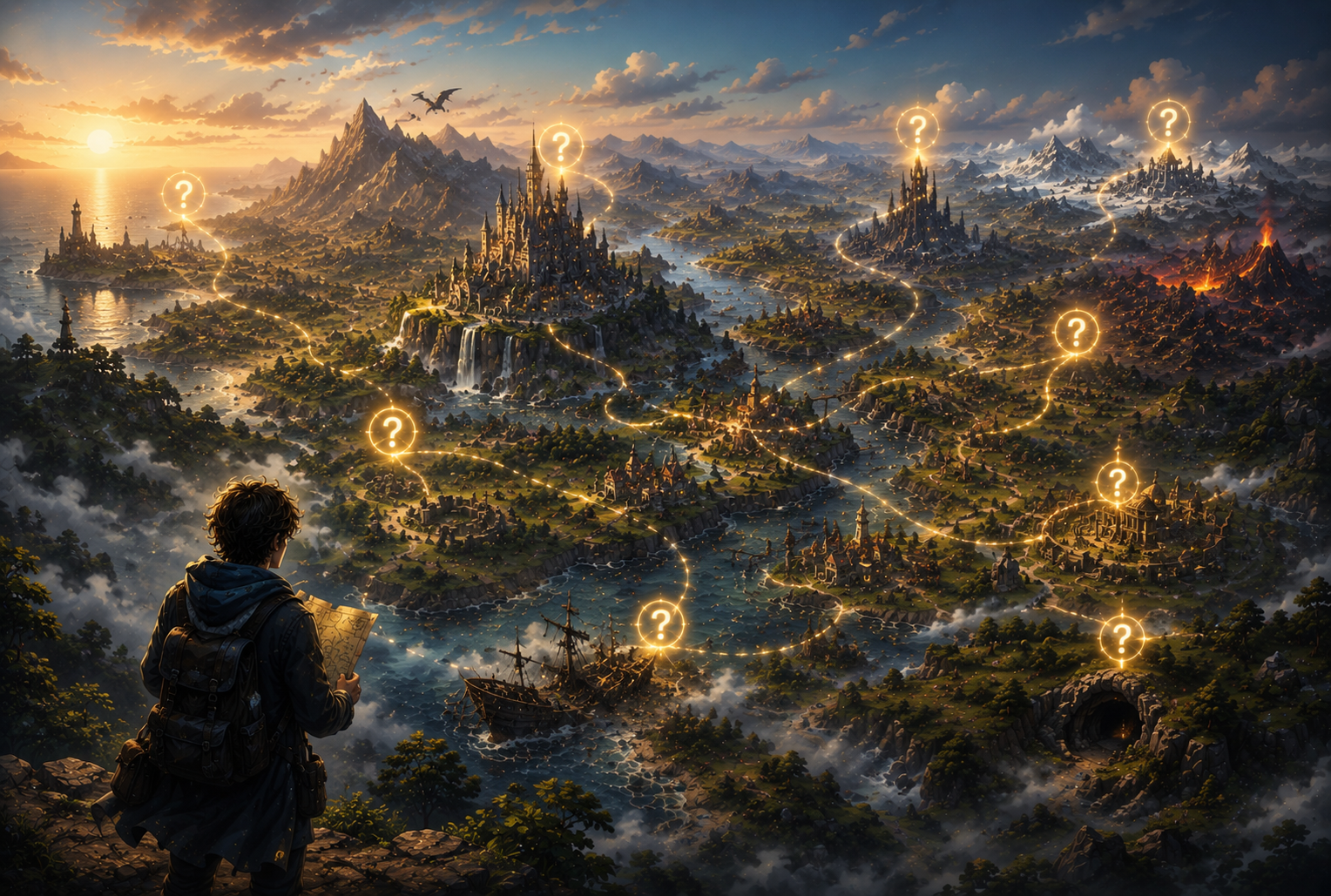
Unanswered questions often become the foundation for future stories, discoveries, and world expansion.
Worlds As Systems
One of the most significant insights from development was that worlds are not simply collections of stories. Worlds behave more like systems.
They contain:
- People
- Places
- Institutions
- Relationships
- History
- Memory
- Unanswered questions
Stories emerge from interactions within the world. The world itself becomes the primary structure.
At Blue Banana Media Studio, this eventually led to a larger idea: Worlds are the unit of meaning. Stories emerge from worlds. Not the other way around.
Looking Forward
The process continues to evolve. Future directions may include:
- World memory systems
- Spatial intelligence systems
- Continuity validation
- AI-assisted production planning
- Visual continuity systems
The tools may evolve. The infrastructure may evolve. The workflows may evolve.
The central principle remains unchanged. Use AI to accelerate discovery. Use humans to determine what matters. Preserve knowledge so it can continue to grow.