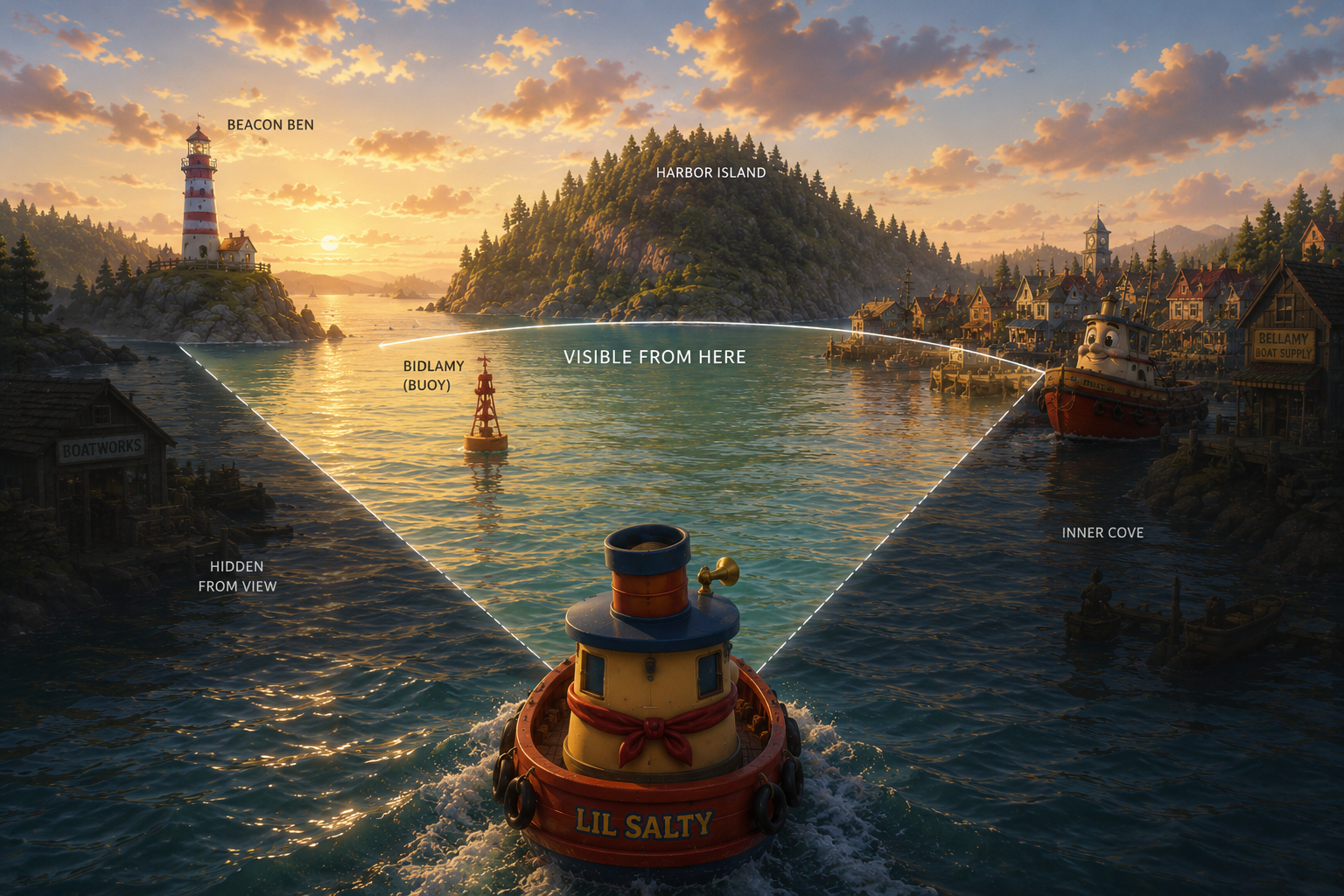
Spatial Memory
How worlds preserve routes, landmarks, visibility, and the spatial truth that makes stories feel real.
Worlds are more than collections of places. They are relationships between places.
Knowing that Beacon Ben exists is world memory. Knowing where Beacon Ben stands, what can be seen from there, and how travelers reach him is spatial memory.
Spatial Memory helps worlds remain navigable, believable, and consistent as stories grow over time.
Spatial Memory helps worlds know where things belong.
Why Spatial Memory Matters
Without spatial memory:
- Landmarks drift
- Distances feel wrong
- Routes become inconsistent
- Scenes lose continuity
With spatial memory:
- Worlds remain navigable
- Journeys feel meaningful
- Locations stay connected
- Movement feels believable
Most people never consciously notice good spatial memory. But they quickly feel when it is missing.
Worlds feel believable when space remains truthful.
Landmarks, Routes, and Distances
Places become meaningful through relationships. A lighthouse matters because it sits at the harbor entrance. A buoy matters because it marks a channel. A harbor matters because routes connect it to the larger world.
Distances matter because stories happen while moving. Journeys create anticipation. Journeys create discovery. Journeys create meaning.
Landmarks
The places that help us understand where we are.
Routes
The paths that connect places together.
Distances
The scale that gives movement meaning.
Stories happen while moving.
Visibility Paths
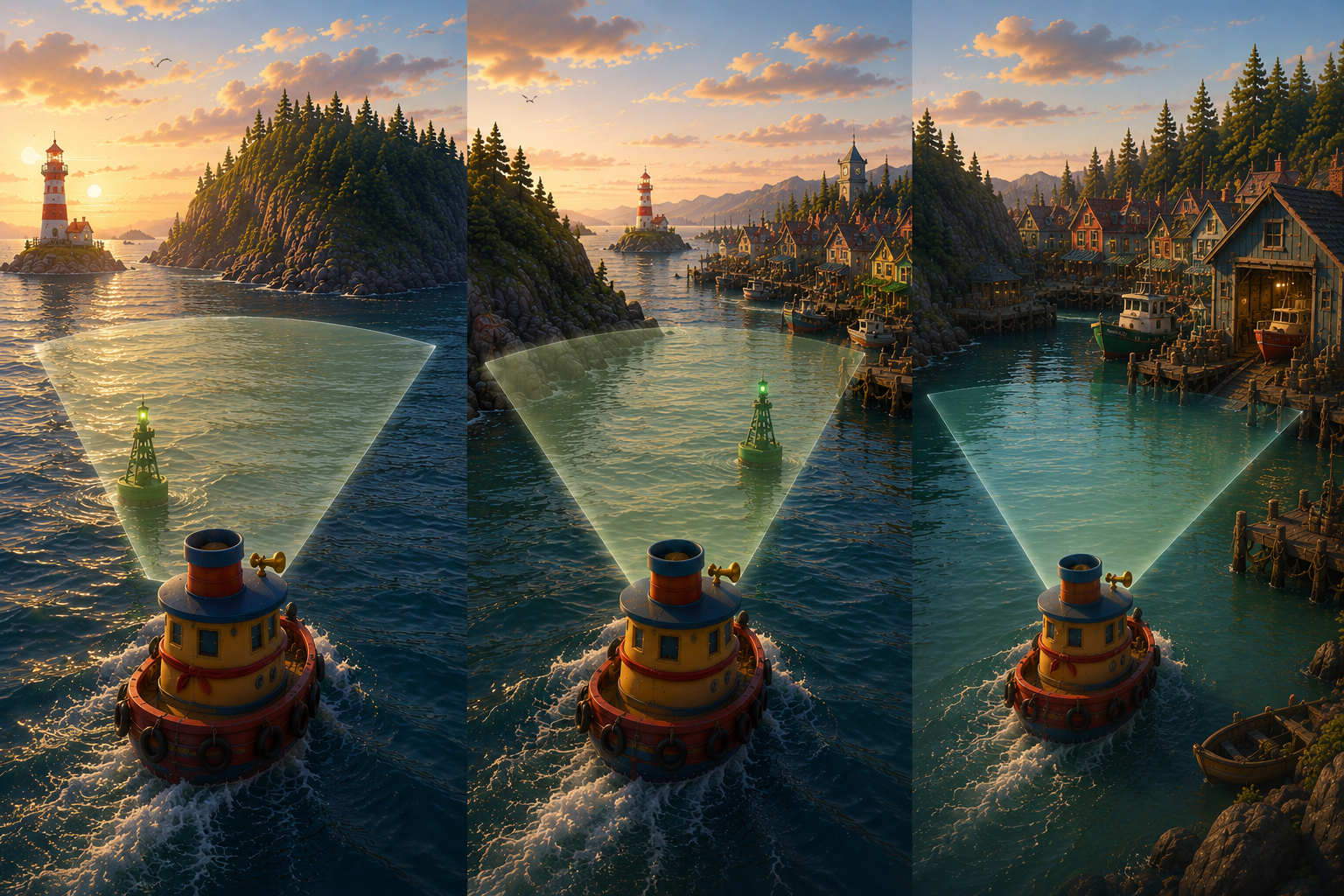
Most maps answer: “What exists nearby?”
Spatial Memory asks a different question: “What can be seen from here?”
Visibility depends on position, direction, distance, obstacles, and elevation.
As characters move through a world: places appear, places disappear, landmarks emerge, horizons change.
The world itself remains the same. Perspective changes what becomes visible.
Stand here. Look that way. What do you actually see?
Spatial Relationships
Spatial Memory is not simply about where things are. It is about how things relate to one another.
Boatworks connects to docks. Docks connect to water. Water connects to routes. Routes connect to destinations.
When those relationships remain true, the world feels believable. When they break, the world begins to feel wrong.
Spatial relationships are the hidden structure that allows a world to make sense.
Relationships create spatial truth.
Emotional Geography

Places do not only occupy space. They occupy meaning.
Open water feels different from a protected harbor. A harbor entrance feels different from an inner cove. A lighthouse feels different from a shipwreck.
These feelings emerge from the structure of the world itself. The geography creates the emotion.
Places occupy space and meaning.
Spatial Memory In Action
Imagine Lil Salty approaching Tuckaway Harbor.
At first he sees: open water, Bellamy, Beacon Ben.
As he moves closer: Harbor Island grows larger, the harbor entrance becomes clear, new destinations emerge.
Entering the Inner Cove changes the experience again.
The world has not changed. His position has changed.
Spatial Memory helps preserve those relationships so the journey remains believable every time it is told.
The world stays the same. Perspective changes.
Looking Ahead
As worlds expand across books, illustrations, videos, games, and future experiences, spatial memory becomes increasingly important.
The same spatial model can support storytelling, visual development, production planning, continuity systems, and future world intelligence systems — while preserving the relationships that make the world feel real.
Spatial Memory helps worlds remain coherent as they grow.